A child sitting cross-legged

I initially thought that you and Mom invented this diabetes to control me.

— A founder’s son, on diagnosis day

You become responsible, forever, for what you have tamed.

— Antoine de Saint-Exupéry, The Little Prince (spoken by the fox)

Foxy
Pediatric chronic disease · Companions for kids · Platform

Companions that hold the line for kids living with chronic conditions.

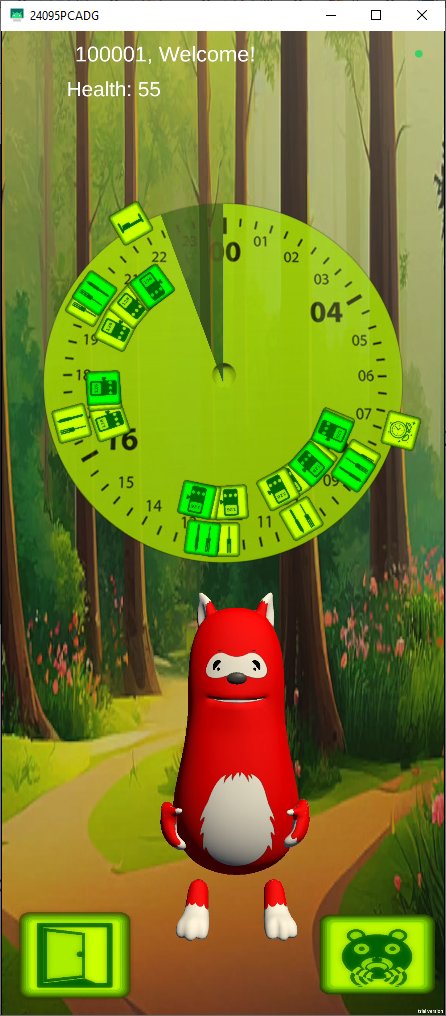
DiaHeroes builds clinically-grounded mobile companions for children with chronic disease. We start with type 1 diabetes — the hardest case, and personal to two of three founders, who are parents of T1D kids — and we’ve built the architecture to extend to type 2 diabetes, childhood obesity, asthma, epilepsy, and pediatric oncology. A small fox named Foxy keeps the daily routine bearable.

Foxy character

A child with a chronic condition lives in a world where forgetting lunch is not a small thing. A companion that does not register the asymmetry between “forgot lunch” and “had a great lunch” is a companion that has nothing to teach.

— From the design account

DiaHeroes app showing schedule dial and Foxy character

  Live build · iter 13

01 · The problem

Adherence is the hard part, and it’s where outcomes live or die.

Children living with chronic conditions face routines that do not negotiate. For a child with type 1 diabetes that means up to twenty events a day — meals, glucose measurements, insulin timing, exercise, sleep — all on a schedule the disease imposes and the child must keep. For a child with asthma, epilepsy, or in oncology treatment, the structure is different but the shape is the same.

The medical evidence is unambiguous: adherence is the dominant lever for long-term outcome, and adolescence is where it most often breaks down. The clinical literature is full of interventions that work in the clinic and fail at home.

The reason is not that children don’t care. The reason is that the routine is unfair, and existing tools either pretend it isn’t — cheerful gamification that wears off — or punish the child for slipping, producing apps the child stops opening. Neither holds.

DiaHeroes is the third option: a companion that names what is unfair, holds the line anyway, and stays warm on the bad day.

21%
of adolescents with T1D meet glycemic goals set by the American Diabetes Association.
ADA · 2023 Standards of Care
~1.2M
children and adolescents living with type 1 diabetes worldwide; growing ~3% annually. Childhood obesity, asthma, and epilepsy add tens of millions more.
IDF · WHO · global pediatric data
Up to 20 events
a day a T1D child is asked to handle. The schedule is the disease — and it is the lever the companion learns to support.
DiaHeroes schedule model
02 · The framework

Three ways to live with a hard contradiction. Only one is sustainable.

Living with a chronic condition is, structurally, an exercise in holding a contradiction every day. The body wants what the condition forbids. Pediatric care recognizes three modes a child can settle into. Our companions are built around the third — and because the framework is about the structure of the contradiction, not the specifics of one disease, it travels.

a.
Denial

The kid pretends the condition isn’t there. Eats whatever, hides from consequences, skips medications. Well-documented in adolescence; precedes the worst medical outcomes. Cheerful gamification reinforces this mode.

b.
Cynical resignation

The kid acknowledges everything cynically, complies grudgingly. Develops the depression and disengagement clinicians fear. Punishing or scolding tools reinforce this mode.

c.
Tensioned dwelling

Yes, this is unfair. Yes, I have to take the medication / measure / pace myself anyway. Both true. Held without collapse. The child remains agent of their own care. This is what’s associated with strong long-term outcomes.

DiaHeroes thesis
Foxy holds the tension. He does not let the kid into denial — no pretending the routine doesn’t matter — or into cynicism — no “fine, whatever” — and he does not crush them on the bad day. The same posture works for any condition where a child must keep a routine the body resists.
03 · From T1D to a platform

Same problem shape. Different conditions.

The structural problem we solve is not specific to glucose. It’s the problem of a child living with an unfair routine that does not negotiate, where adherence is the dominant outcome lever and where existing tools fail by being either saccharine or stern.

That problem appears, with the same shape, across pediatric chronic disease. We start with type 1 diabetes because it is the hardest case — densest schedule, most unforgiving consequences — and because two of three founders live it as parents. T1D-first is evidence of capability, not the ceiling.

The architecture — the framework, the asymmetric correction, the structured memory, the principled tone — is condition-agnostic. The product roadmap is condition expansion, not feature expansion.

Now
Type 1 diabetes (T1D)
The reference case. Densest schedule. Founder-personal. Validates the architecture under the hardest conditions.
Next
Type 2 diabetes & childhood obesity
Same adherence problem; behavior, food, and movement at the center. Largest addressable pediatric population.
Adjacent
Asthma & epilepsy
Medication adherence and trigger management. Acute consequences for non-adherence; clear clinical demand.
Further
Pediatric oncology & other chronic conditions
Routine, side-effect tracking, emotional load — where a principled companion is most needed and least available.
04 · A day with Foxy

What the companion actually does, hour by hour.

Up to twenty events, end-of-day reflection, and a small fox whose mood tracks the day. Below is a representative T1D day — not a marketing scenario. Real schedule, real prompt structure.

07:00
Wake
App opens. Foxy greets. If yesterday’s session left a topic open, Foxy picks up the thread by name — the kid’s topic, remembered.
07:30
First measurement
Tap-to-confirm. The dial fills. Adherence math runs in real time; on-time taps decay gently, missed taps register without scolding.
08:00
Breakfast
Foxy can talk about anything the kid wants — ships, dinosaurs, school. The conversation log is anonymized; topics accumulate across days so Foxy actually remembers.
10:00 – 16:45
Snacks, lunch, school, more measurements
Schedule events surface as taps. If the kid skips, the dial registers it; if the kid catches up, the system rewards recovery faster than it punishes the slip.
20:00
Dinner
Last meal of the schedule. Foxy notes what’s been done, what’s pending. Tone calibrated by the day’s health trajectory.
22:00
Goodnight
End-of-day message calibrated to the day: a descriptive note about how the day went, plus an emotional beat. On poor days, something like: “I’m still dim today. Tomorrow is a place to start.”
05 · What we built

A system, not a chatbot.

Behind the fox: a measurable adherence model, durable per-child memory, structured prompt architecture, and clinical-safety constraints. Each piece earns its place by addressing a specific failure mode that an off-the-shelf LLM would otherwise produce.

01

Asymmetric adherence math

The health score recovers faster than it declines. The cost of a bad day is real; the recovery from one is also real, and faster. Encoded as math, not as language — and tunable per condition.

02

Bounded structured memory

Each session writes a bounded structured summary: topics, facts covered, engagement signal, behavioral correction. The fox remembers what mattered without retaining what shouldn’t persist. Fully anonymized.

03

Continuity-by-default

A child who talked about ships yesterday is asked, today, whether they’d like to continue. Determinism creates ritual; ritual creates the perceived continuity that makes a character feel real.

04

Calibrated end-of-day messaging

Every goodnight is paired: a descriptive note about the day’s trajectory plus an emotional beat. Tone is calibrated by the health trajectory and clinically reviewed. Foxy’s voice is principled, not improvised.

05

Strict pediatric anonymity

No names, no medical numbers, no identifiable details persist anywhere. Conversations are logged for offline analysis; durable memory is the structured summary. Designed to clear pediatric data-protection bars from day one.

06

Multilingual from the start

English, Russian, Hebrew. Speech-to-text and text-to-speech localized; Foxy’s voice and persona consistent across languages. Trial sites in multiple geographies.

06 · Where we are

Working software, clinical pipeline, principled design.

13
Iterations of the dialogue subsystem shipped and tested.
Architecture stable
3
Languages supported. Persona and voice cohesive across all three.
EN · RU · HE
up to 20
Daily events tracked per child, with adherence math and engagement scoring.
Production schedule
Q3 26
Planned start of clinical evaluation in a major university hospital.
Protocol drafted
Roadmap
Now
Memory architecture closed. Continuity, anonymity, smart truncation all shipped and tested in iter-13.Working software on Android. Working MVP for parents. Web application for registration and initial survey. Pilot feasibility study commences this week.
Next month
Engagement formula calibration on real usage data. Wellbeing check-ins.Real children, real schedules.
Next quarter
Concordance. App-mediated negotiation of lighter, achievable schedules between child, parents, and caregivers — the companion as trusted intermediary, not enforcer.Clinically grounded; multi-stakeholder by design.
Clinical evaluation protocol with university hospital partner. Evidence base for the framework.Drafting in progress.
Next year Q1
Parent companion app with empty-mouth mediation; iOS port; expanded language coverage; first non-T1D condition in pilot.Architecturally prepared.
07 · The intellectual foundation

The design rests on a framework, written down.

The fox is the friend who says: this is hard and unfair, AND we measure anyway, AND we get a tale after, AND tomorrow is a new day. Foxy holds the tension.

— From DiaHeroes ethics summary

Most companion apps are designed by tone preference. DiaHeroes is designed from a written framework that connects pediatric medicine, developmental psychology (Kohlberg), and a particular philosophical claim: that moral seriousness is the work of staying with a contradiction one cannot resolve.

That framework is not decoration. It generates the design choices: the asymmetric scoring, the calibrated end-of-day messaging, the structured memory, the refusal to gamify or to scold. Every parameter is defensible from the framework, and revisable if the framework changes. And because the framework is condition-agnostic, the same posture extends naturally to T2D, obesity, asthma, epilepsy, and oncology.

This matters for clinical partners, for regulators, and for parents: we can answer the question “why is the app shaped this way?” with more than “it tested well.” The shape follows from a position that has been written down and can be examined.

Request the design account
08 · Privacy, anonymity, and AI safety

Built for kids — with the guardrails that implies.

Two questions any pediatric AI product must answer plainly: how is the child’s identity protected, and how is the model kept on age-appropriate ground? Below, the position in plain language; the formal policy text follows each.

Anonymous by design

Registration is anonymous from the first tap. A child signs up without name, email, phone, or any other identifier. Each user is identified internally by a six-digit code and a four-digit password — that is the entire account. All data on our servers is stored against that code and nothing else.

When physiological data flows into the system — for example, glucose readings or HbA1c — it is conveyed by the patient’s clinician, within the existing clinical relationship, using only the six-digit code. We never receive the patient’s name, contact details, or any other identifier through that channel.

The one place this calculus changes is direct CGM integration. Logging into a CGM data store will, by the nature of those systems, require personally identifying credentials. When we ship that integration we will treat it as a regulated data path and comply with the applicable laws and standards explicitly — not retrofit them.

Formal policy text

Currently, user registration and use of the app are completely anonymous. Users register without providing personal information and are then identified by a 6-digit code and a 4-digit password. All user information is stored on our servers only under this number. We do not ask users to provide contact information, names, or other personal information.

As to personal information required to get access to a patient’s CGM data, the access to this data is performed by the patient’s doctor within the framework of usual clinical practice. When conveying information about physiological data (glucose levels, glycated hemoglobin and other) to the application owners, the doctor will always use only the 6-digit code of the patient without disclosing any personal data identifying the patient (names, contact information, etc.).

In the future, when integrating with CGM systems, we will require personal information to log in to the CGM data storage system. When this option is implemented, we will ensure compliance with laws and regulations taking this into account.

AI on a short leash — and red-teamed

Letting children aged 5–12 talk to a generative model raises an obvious worry: that the conversation drifts somewhere it shouldn’t, or that a curious child finds a way to push it there. Foxy’s prompt structure encodes the audience explicitly — tone, vocabulary, and topic boundaries are calibrated to the age range and held by the system, not by goodwill.

We also know that some children are creative about jailbreaks, and we treat that as a design problem rather than a hope. Before any patient testing, a dedicated red team is tasked with attempting to subvert Foxy — trying to elicit inappropriate language or topics — and the prompt architecture is hardened in response. The findings feed back into the system before children see it.

Formal policy text

The use of artificial intelligence by children and adolescents raises concerns about the possibility of discussing inappropriate topics or using inappropriate language. With this in mind, the AI prompts are designed with a reminder that users are aged 5–12 years old and should adhere to the ethical context and content of communication within the appropriate age range.

However, there are known cases of “creative” children and teenagers learning to “hack” the AI and access inappropriate content. To prevent such cases, before testing the DiaHeroes app on a control group of patients, a team of testers was tasked with attempting to “hack” the AI dialogues and access inappropriate topics or language. The results of this test will be used to refine the prompts to prevent such situations.

Get in touch

For investors, clinical partners, and thoughtful collaborators.

If you work with pediatric chronic disease, run a clinic that wants to evaluate the system, or are looking to back work where the philosophical foundation matters as much as the product — let’s talk.